
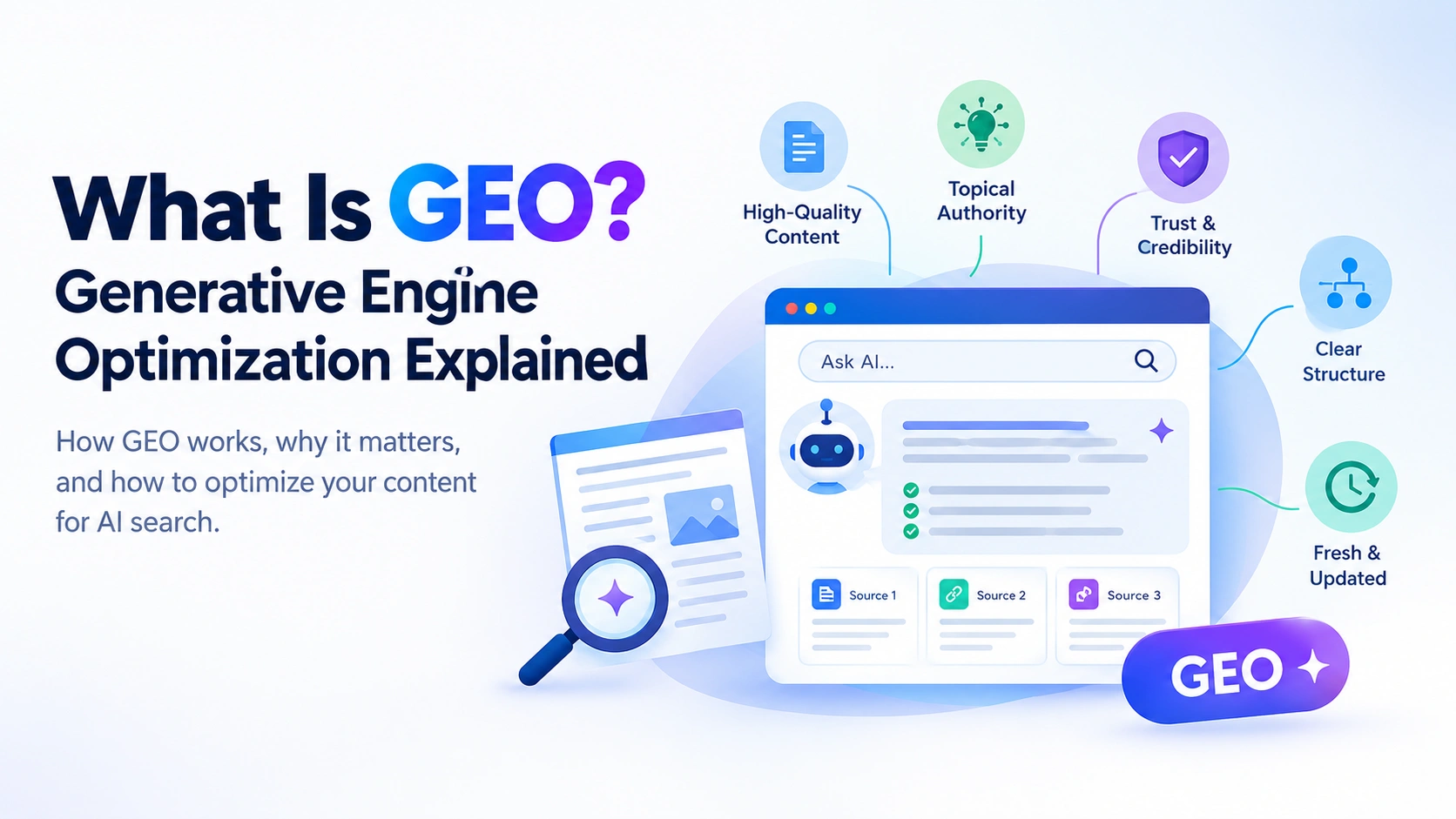
What Is GEO? Generative Engine Optimization Explained
Search is changing rapidly. People are no longer relying only on traditional search engines to find information. With AI-powered tools such as ChatGPT, Google AI search experiences, Microsoft Copilot, and other generative search platforms, users can increasingly receive direct answers instead of browsing through multiple websites.
This shift has created a new area of digital marketing called Generative Engine Optimization, or GEO.
But what exactly is GEO? How does it work? How is it different from SEO? And how can businesses optimize their content for AI-powered search?
This question-answer guide explains everything you need to know about GEO in simple terms.
What Is Generative Engine Optimization?
Generative Engine Optimization, commonly called GEO, is the practice of optimizing online content so that it has a better chance of being discovered, understood, referenced, or included in responses generated by AI-powered search and answer engines.
Traditional SEO focuses heavily on improving visibility in search engine results pages. It focuses on visibility within AI-generated responses and generative search experiences.
The goal is not simply to rank for a keyword. It is to create useful, authoritative, well-structured information that generative systems can understand and potentially use when answering user questions.
How Does GEO Work?
GEO works by making content easier for AI systems to understand, evaluate, and potentially reference.
The strategy generally includes:
- Creating accurate and useful content
- Answering specific user questions
- Demonstrating expertise and topical authority
- Structuring information clearly
- Supporting important claims with reliable sources
- Keeping content relevant and up to date
- Building a strong website and brand presence
AI-powered search systems may use multiple signals when determining which information to include in generated answers. Because these systems differ in how they retrieve and process information, there is no single optimization technique that guarantees inclusion.
Why Is GEO Important?
The way people search for information is evolving.
Instead of entering a short keyword and opening several results, users can increasingly ask detailed questions and receive summarized answers from AI-powered systems.
This means businesses need to consider more than traditional search rankings.
A strong Generative Engine Optimization strategy can help businesses work toward greater visibility in emerging AI search experiences by producing content that directly addresses user needs and provides useful, trustworthy information.
What Is the Difference Between GEO and SEO?
SEO stands for Search Engine Optimization, while GEO stands for Generative Engine Optimization.
It generally focuses on improving visibility in traditional search results. GEO focuses on increasing the likelihood that content is understood, surfaced, or referenced in generative AI responses.
The two approaches overlap significantly.
For example, both SEO and GEO benefit from:
- High-quality content
- Strong topical relevance
- Clear website structure
- Useful answers
- Credible information
- Good user experience
- Relevant keywords and entities
GEO should therefore not necessarily replace SEO. Instead, businesses can incorporate GEO principles into a broader search strategy.
Does GEO Replace SEO?
No. GEO does not automatically replace traditional SEO.
Search engines continue to play an important role in how people discover websites, products, services, and information.
At the same time, generative search is creating additional ways for people to discover information.
A modern search strategy can therefore consider both traditional search visibility and visibility within AI-powered search experiences.
How Can I Optimize My Content for GEO?
There is no guaranteed formula for appearing in AI-generated answers, but several practical content principles can support GEO.
1. Answer Questions Directly
Create content that clearly answers the questions your audience is asking.
Instead of providing vague introductions, address the main question early and explain the answer clearly.
2. Create Comprehensive Content
Cover the important aspects of a topic rather than focusing on a single keyword repeatedly.
For example, an article about Generative Engine Optimization could explain its definition, benefits, implementation, differences from SEO, optimization techniques, tools, and common mistakes.
3. Use Clear Structure
Use descriptive headings, short paragraphs, bullet points, tables, and FAQ sections where appropriate.
A clear structure makes information easier for both readers and automated systems to interpret.
4. Demonstrate Expertise
Provide useful information that reflects genuine expertise.
Include relevant examples, original insights, data, explanations, and practical recommendations where appropriate.
5. Support Important Claims
When making factual or statistical claims, use credible and relevant sources.
Reliable references can help demonstrate that the information is based on evidence rather than unsupported statements.
6. Keep Content Updated
Information can become outdated quickly, particularly in technology and AI.
Review important pages periodically and update outdated statistics, examples, terminology, and recommendations.
What Are GEO Ranking Factors?
Unlike traditional search ranking factors, there is no universally established list of Generative Engine Optimization ranking factors that guarantees visibility in generative AI results.
However, several characteristics are commonly relevant to creating content suitable for AI-powered search:
- Relevance to the users question
- Accuracy
- Content quality
- Topical depth
- Clear organization
- Author and brand credibility
- Reliable supporting sources
- Freshness
- Original information
- Strong contextual relationships between topics
Different AI search systems may use different retrieval and ranking methods, so results can vary from one platform to another.
Can AI-Generated Content Help With Generative Engine Optimization?
AI can help with content research, brainstorming, outlining, editing, and optimization.
However, simply publishing large amounts of automatically generated content does not guarantee better visibility.
Effective content should provide genuine value, be accurate, address the users needs, and add useful information rather than simply reproducing existing material.
AI can be part of a content workflow, but quality control and human oversight remain important.
What Is AI Search Visibility?
AI search visibility refers to how prominently a brand, website, product, or piece of information appears within AI-powered search and answer experiences.
For example, a user may ask an AI search system for recommendations or an explanation of a topic. The system may provide an answer that references information from several sources.
Being represented accurately within those responses can become an important part of digital visibility as generative search adoption grows.
How Can I Improve My AI Search Visibility?
Start by understanding the questions your target audience asks.
Then create authoritative content that provides clear answers to those questions.
A practical approach includes:
- Research your audience and their questions
- Identify important topics and entities
- Create comprehensive resources
- Structure content clearly
- Provide evidence for important claims
- Build topical authority
- Keep important information updated
- Monitor how your brand appears in AI search experiences
Generative Engine Optimization should be treated as an ongoing content and search strategy rather than a one-time optimization task.
What Are the Benefits of GEO?
Generative Engine Optimization can help businesses prepare for changes in how people discover information online.
Potential benefits include:
- Greater visibility in AI-powered search experiences
- Better coverage of user questions
- Stronger topical authority
- Improved content structure
- More opportunities for brand discovery
- Better alignment with conversational search behavior
The actual impact will depend on the industry, audience, content quality, search platform, and many other factors.
What Are GEO Tools?
Generative Engine Optimization tools are platforms designed to help businesses research, monitor, or analyze visibility within AI-powered search experiences.
Depending on the tool, features may include:
- AI visibility tracking
- Brand mention monitoring
- Citation analysis
- Competitor monitoring
- Prompt tracking
- Content analysis
- Generative search reporting
As the GEO ecosystem continues to develop, businesses should evaluate tools based on their specific goals rather than relying on a single platform or metric.
Is GEO Important for Small Businesses?
Generative Engine Optimization can be relevant to businesses of all sizes.
Small businesses can focus on creating highly specific, useful content that answers questions within their particular niche.
For example, instead of trying to cover an extremely broad topic, a local service provider could create detailed resources answering common customer questions about its services, pricing factors, processes, and industry.
This can help establish topical relevance and provide useful information for potential customers.
What Are Common GEO Mistakes?
Some common mistakes include:
- Creating content solely for AI systems
- Publishing low-quality AI-generated articles
- Repeating keywords unnaturally
- Making unsupported claims
- Ignoring traditional SEO
- Focusing only on one AI platform
- Failing to update outdated information
- Writing generic content without original value
- Measuring visibility using only traditional rankings
The strongest approach is generally to create content for people first while making the information clear and accessible to search and AI systems.
Is GEO the Future of SEO?
GEO is becoming an important consideration as AI-powered search continues to develop.
However, traditional SEO remains relevant because websites still need to be discoverable, technically accessible, useful, and authoritative.
Rather than thinking about GEO and SEO as competing strategies, businesses can consider them complementary parts of a broader search visibility strategy.
What Is the Best GEO Strategy?
A practical Generative Engine Optimization strategy starts with the audience rather than the technology.
Understand what people want to know, create reliable answers, organize those answers clearly, and establish expertise around the topics that matter to your business.
The most sustainable approach is to focus on creating genuinely useful information rather than attempting to manipulate AI-generated results.
Frequently Asked Questions About GEO
What does GEO stand for in digital marketing?
GEO stands for Generative Engine Optimization. It refers to strategies designed to improve how content is discovered, understood, and potentially referenced by generative AI search and answer systems.
Is GEO the same as SEO?
No. SEO primarily focuses on visibility in traditional search results, while GEO focuses on visibility within generative AI search experiences. However, the two disciplines share many foundational principles.
Can GEO guarantee that my website will appear in AI answers?
No. AI search systems use complex and changing retrieval and ranking processes. No legitimate GEO technique can guarantee that a particular website will appear in generated answers.
Does GEO require technical SEO?
Technical SEO can still be important. A website should be accessible, crawlable, well structured, and provide a good user experience. GEO works alongside these foundational SEO practices.
Should businesses invest in GEO?
Businesses that depend on online discovery may benefit from understanding how generative search is changing user behavior. GEO can be incorporated into an existing content and SEO strategy rather than treated as a completely separate discipline.